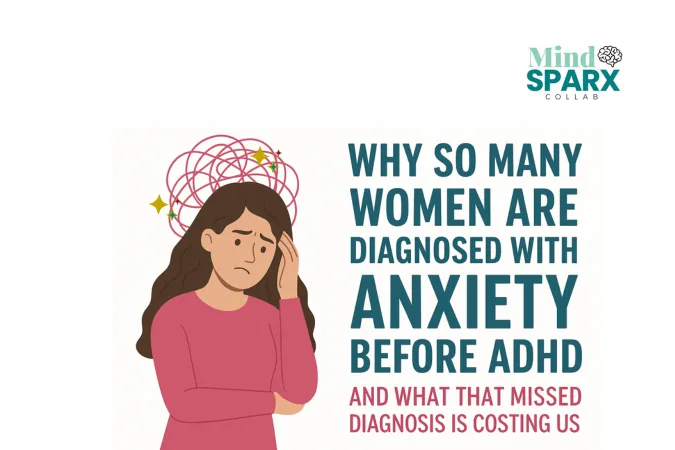
Why So Many Women Are Diagnosed with Anxiety Before ADHD (And What That Missed Diagnosis Is Costing Us)
Why So Many Women Are Diagnosed with Anxiety Before ADHD (And What That Missed Diagnosis Is Costing Us)
“I thought I was just anxious. I thought I was just depressed. Turns out—I was undiagnosed ADHD.”
If that sounds familiar, you’re not alone. In fact, women are twice as likely as men to be diagnosed with anxiety or depression in the year leading up to their ADHD diagnosis. That’s not a coincidence—it’s a pattern, and it’s one we need to talk about more.
Let’s pull back the curtain on what’s really happening—and what you can do about it.
Misdiagnosis Is Not Misfortune—It’s Misdirection
For so many women, especially those with predominantly inattentive ADHD, the symptoms don’t match the hyperactive stereotype we’ve been taught to look for.
Instead of bouncing off the walls, you’re:
zoning out in meetings
overwhelmed by to-do lists
emotionally exhausted by the constant loop of “Why can’t I just get it together?”
Those symptoms look a lot like anxiety or depression. And unfortunately, that’s often exactly what gets diagnosed—first.
Multiple studies confirm it: 14% of girls with ADHD are prescribed antidepressants before they’re ever treated for ADHD—compared to just 5% of boys.
Here’s why that matters: Misdiagnosis delays the right treatment. And when you’re a woman already trying to juggle societal expectations, work-life chaos, and invisible executive function challenges, that delay hits harder.
The Invisible Struggle of Inattentive ADHD
Unlike the disruptive behaviors more commonly seen in boys with ADHD (which do get flagged earlier), girls and women tend to internalize their symptoms.
We show up as:
“too sensitive”
“too emotional”
“too disorganized”
“too much” and “not enough” at the same time
Sound familiar?
Because our pain presents quietly—through perfectionism, people-pleasing, and chronic overwhelm—it gets overlooked. And that invisibility becomes its own kind of burnout.
Diagnosis Isn’t the End—It’s the Beginning
If you’ve recently discovered you have ADHD, pause and honor that moment. That clarity is powerful. It’s not about slapping on a label. It’s about finally understanding your brain—and giving yourself permission to stop fighting it.
✨ Your brain isn’t broken. It’s just wired differently—and beautifully. ✨
Now it’s time to build systems that work with your wiring. That’s exactly what we do inside the MindSparX Collab™ community.
We don’t hand you rigid routines. We help you:
break free from outdated productivity guilt
rewrite the internal narrative of “I’m lazy” or “I should be able to handle this”
and activate the strategies inside your unique ADHD blueprint.
Want to Take the Next Step?
If this post hit a little too close to home, I encourage you to check out my book “Finish It”—it’s a gentle, brain-smart guide to overcoming distractions and actually completing the things that matter most.
In it, I introduce the FINISH Framework—a compassionate, ADHD-informed method that helps you:
✅ Focus on one thing
✅ Interrupt distractions
✅ Navigate setbacks
✅ Increment your progress
✅ Stay accountable
✅ Honor the win
💡 Grab your copy of Finish It here »
Let’s Normalize the Neurodivergent Journey
Want to keep this conversation going?
Read more in this follow-up blog post that breaks down how emotional regulation, shame spirals, and body-doubling all factor into ADHD awareness.
Better yet—come join the MindSparX Collab™ Community, where late-diagnosed ADHD women are breaking the silence, reclaiming their focus, and building sustainable systems on their own terms.
🎉 No more playing life on hard mode. Just support, clarity, and brain-affirming strategy.
👉 Join the MindSparX Collab Community Now
You deserve strategies that make sense for how you’re wired. And a sisterhood that gets it.


